
Create a Homeschool Schedule that Actually Works for You
Are you totally overwhelmed by the idea of scheduling out all of the homeschool subjects? Here is my step-by-step process to ensure that I create a manageable, yet comprehensive schedule for our homeschool.
When I first started homeschooling, I was so excited to buy all the things. There are so many wonderful curriculum options out there, so it’s understandable. I wanted to provide my children with a well-rounded, engaging education.
But what I realized after a little while, is that I was stuck in a cycle of buying & not using. I wasn’t not using these curriculum items because I didn’t want to, but because I couldn’t realistically get to them in our days.
So, I finally say down and decided I needed to change my planning process. Essentially, I now plan my year out somewhat backwards. I’ll show you what I mean…
Affiliate disclosure: This post may contain affiliate links. As an Amazon Associate this means I will earn a small commission if you choose to purchase through my links. This is at no extra cost to you! Read full disclosure here.
Benefits of Having a Schedule
I actually find having a homeschool schedule to be extremely helpful. Which makes sense, considering I’ve always been the “planner” type. If you find yourself struggling with some of these things, it may be a sign you need a schedule.
- You feel like your school days drag on and on.
- Your other responsibilities are constantly getting ignored.
- You overbuy curriculum you can never get to.
- You end the day feeling completely overwhelmed from decision fatigue.
Taking the time to establish a schedule can help with all of those! I’m not saying it’s a cure all – but it can definitely help reduce chaos and overwhelm once implemented.

How to Make a Homeschool Plan
Grab a simple notebook and pencil, and we’re going to start with the brainstorming process.
Disclaimer: always check your own state homeschool laws to ensure you are including all required subjects in your plans.
Step One – Set Time Limits
First, we’re going to determine our actual capabilities. As in, what amount of time do I actually have to commit to lessons each day without neglecting the other needs within our home and life? This is such a critical step in homeschool planning that gets overlooked and often leads to over buying.
Please don’t take this as me saying to set aside the minimum amount of time you can. We’re trying to find a balance that gives your children sufficient time to learn but also gives you time to tend to the rest of your responsibilities.
It’s important to keep in mind, particularly if you have multiple children, that your time to teach lessons is often longer than that of the child. For example, if you have multiple math lessons to teach, that’s going to add on to your teaching time.
This can be adjusted once we have subjects listed out. But giving myself a realistic chunk of time dedicated to school each day, it where I start.
Step Two – List Your Subjects
Next, list out the required and preferred subjects for each of your children. Make a note of how often you would like to get to each of these subjects within a weekly basis. Include a list of family subjects as well.
While each of my children have their own specific subjects, there are a lot of things we cover together as a family in our “morning time” – which is technically in the afternoon.
In our home, we cover certain subjects daily, including math and language arts. Subjects like history and science may only be 2-3 times a week. Something like Shakespeare or citizenship are only 1 time a week.
Step Three – Assign a Time Limit to Subjects
As you list out your subjects, make a note of about how long a lesson will take and if it can be done independently. If you’re brand new to a subject, a great way to find out of long a lesson will take is to look in the teacher’s guide for recommended lesson lengths.
Articles over at Simply Charlotte Mason, like this one on scheduling, have also been helpful in determining time limits to assign to each subject.
I’ve found that keeping lesson lengths in 5 or 10-minute increments (10,15,20 etc.) is helpful in creating the final schedule. Lesson lengths are good barriers to have in place to ensure that your days don’t get so long that everyone is fatigued and overwhelmed.

Looking for a math program that’s conceptual, hands on, and has built in review? Shop our favorite homeschool math curriculum here!
Step Four – Assign Lessons to Days
Now this is the part that requires some back and forth – and why you’ll want to use a pencil. List out the days of the week, or even just Day 1-5 (or however many days you’ll be doing school each week).
Start by listing out the subjects you want to cover every day. This will probably be your “core subjects” – like math and language arts. Be sure to indicate how long those lessons will take. Then add the subjects that you may only do 2 or 3 times a week.
I try to keep a balance between the length of each day. So if I add a 20 minute history lesson to Monday and Wednesday, I’ll add a 20 minute literature lesson to Tuesday and Thursday. As I put the lesson on a specific day, I mark it off of the list I made in the previous step.
I continue this process until all of the subjects are spread out across the week.
Step Five – Create a Timetable
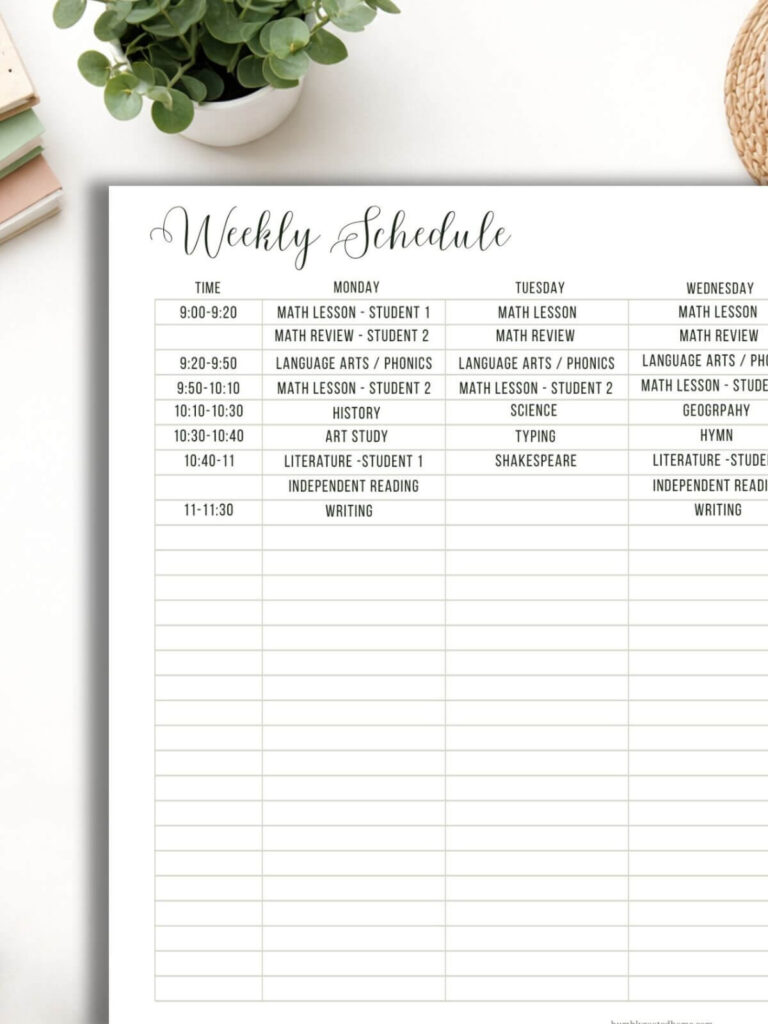
Now that you can pretty easily see what needs to be covered each day, you can create a timetable. This is just assigning lessons to specific time block of the day. It gives structure to the day and lets everyone know what they need to be working on at specific times. You can actually even omit the time piece, and instead just list out the length of each block (see the example schedules below).
This is also where you can determine how to pair up subjects if you are teaching multiple students. I feel like the best way to explain this step is just to show it, so here are a couple of examples.
Want this free printable timetable? Head over to this post: Free Timetable Printable for Homeschool Scheduling
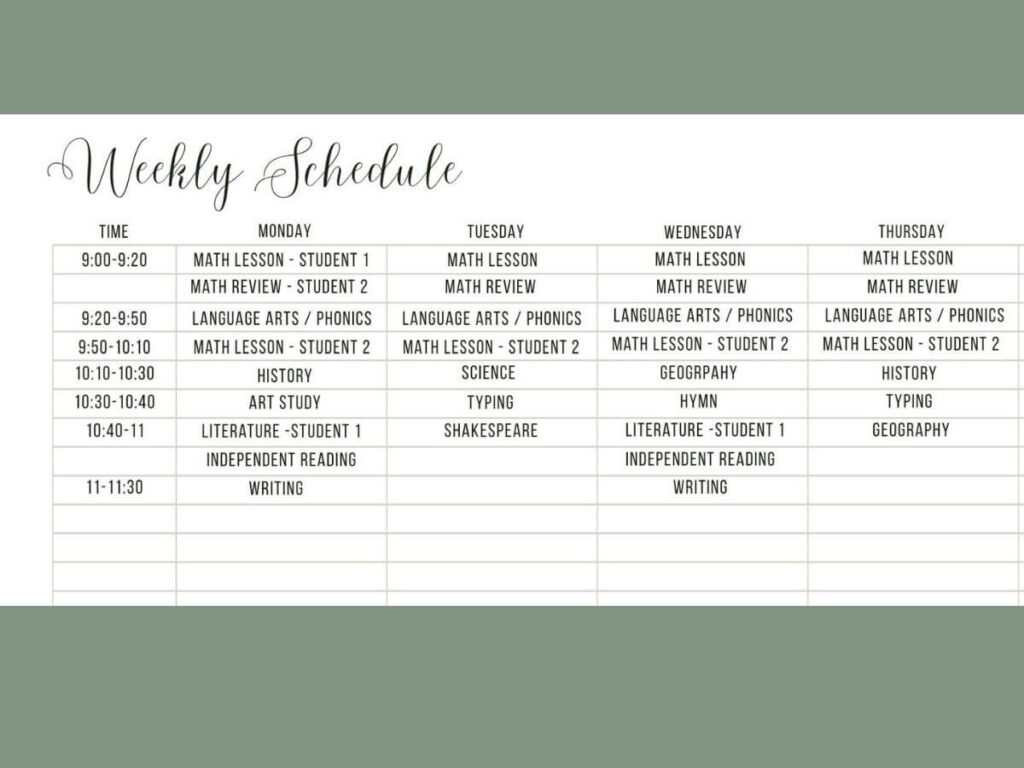

You’ll notice that I different lessons of the same length on various days. I also utilized the same time block for multiple lessons if one of my children can complete them independently.
At the end of all this, I can pretty easily see how many hours of school I have planned out for each day. If this fits within my start and end time of school hours (or pretty close to it), great! If not – it probably means I was a bit too ambitious with my plans and need to scale certain things back.
I hope this is helpful in establishing your own schedule! Let me know if you have any questions, and be sure to join me over on Youtube for all the Homeschooling & Homemaking content!
